Friday, 23 March 2018

"I like your wheelchair!" & thoughts about accepting assistive devices

We were celebrating! We had the wheelchair parked at school for the whole of the first term... and then one day... she rode it and owned it! I admit there may have been some bribery involved (pink lunchbox like her friend, Gia), but at least she never looked back.

Redd Tedd was so excited about the wheelchair that he came home with Sarah-Hope for the weekend! And that happened to be a weekend when we were going camping in the Cedarberg for a friend's 40th. 


We drove in the bus to the Cedarberg and took the wheelchair with. The ground was firm enough there for Sarah-Hope to drive around the campsite a bit with the wheelchair which was great. We had a mobile ramp so also managed to put that down over a little canal so Sarah-Hope could make her way between our site and the next door one.


Kids were running around, some on bikes. A beautiful moment stayed with me when my friend's son, Charlie, came over. This was their simple and beautiful exchange:

Charlie: I like your wheelchair.

Sarah-Hope: I like your bike. 

What I love about young children is that they can see the clear benefit of getting to drive yourself around in a wheelchair. In fact, they want a turn themselves! Sarah-Hope is the lucky one who gets to drive AND who even has a little hooter. But what a lovely problem to have - when people are wanting to be around it.

Adults usually have an automatically sad association with the wheelchair. I can understand this - they can sense the loss it represents. 

I'm always thinking about how these assistive devices are interpreted in the world around Sarah-Hope's world. My hope would be that they promote discussion and inclusion. 

Sarah-Hope's Grade R Teacher, Pam Berry, had an idea about a tablet that Sarah-Hope would start using occasionally in class. She could invite a friend to join in with her by doing an activity on the tablet. That way, the potential for the tablet to separate Sarah-Hope from the class was reduced. This idea has been an important one in designing Sarah-Hope's support going forward in life.

Tuesday, 20 March 2018

Where does my help come from?

It was so interesting to see Sarah-Hope engage with a new school environment. She was so excited. In her pretend play in the months before, she had been talking about facilitators. She had been driving the wheelchair around on holiday at speed and with joy. And then as a six year old she suddenly enters a new space with new children around her along with a fresh sense of wanting to be one of them. She wants to do things on her own and not need the help of her facilitator. She wants to walk to the hall by herself like the others and not go in a wheelchair. Even if it meant walking on her knees the whole way there and back, a couple of times a day!
 
 
The school mentioned to me that they were chatting to her about it, that the wheelchair and facilitator are part of her story. And she also began to realize, I think, that she couldn't keep up with the other kids. A hard one, but regular part of the grief cycle, acknowledging her losses. But then that resolved. (see the next post on celebrating about the wheelchair).
 
She also had to make the adjustment from the teacher assisting her (which had been the case in the previous little school) to asking her facilitator to do so. I had the same battle at home - I occasionally had someone at home, I would request that she ask them rather than me to take her to the toilet or get something that was out of reach for her. In my mind she had to realize that she needed to accept the assistance that was provided for her - as she wouldn't always be in a position to choose this in her life. And it was important for her to exercise the muscle of asking for help from anyone around her in a way that made them comfortable assisting, even if they were strangers. This ability would help her navigate institutions and unpredictable events. And she improved - from reliance on her teacher only, to including her facilitator and then also friends later in the year. 
 
 
One afternoon we were getting our things together to go for a swim. People usually feel uneasy watching me carry my kids (Sarah-Hope as she needs to be carried, and Libby as she wants to get the same assistance as her sister), as well as their stuff. But because I have often needed to figure out how to get through these logistical challenges on my own, I don't ask for help until I really need it. So one day Sarah-Hope says to me, 'why don't you accept help when people offer'? What a question! And I realized how important it is to model those things which you want your children to catch. Yes, she needs help. But so do I.

As I've pondered much in the last few years, I have come to believe that long term living in interdependent community is the only sustainable solution. Every person deserves to be supported, and have the privilege of strengthening others. Working out what load we should carry on our own, and what we should shoulder with others is one of wise discernment and in my family it changes frequently depending on health levels in particular... and then boundaries have to be reestablished in terms of who does what and how we ask for and receive support. It is not always clear cut. And so because of the amount of support I've needed since becoming a mum, I've wanted to reserve it until I really do need it. My asking for support shouldn't be driven by the immediate response others have when they see me in a given situation. Although sometimes participation in each other's stories can mean sharing not out of desperate necessity but out of the joy of being and doing something together. 

May I model dependence on the Lord's help by receiving and requesting support regularly - and being the Lord's help to others as often, even if its a simple genuine question asked about how someone is or knowing embrace offered with no other words. And may Sarah-Hope know the Lord supporting her through many - and the strength that she can offer to others as well.

Sunday, 21 January 2018

Starting at Red Roots Preprimary School

The school kindly allowed us to have some time at the school grounds the day before it opened. I know Sarah-Hope needs unhurried time to work out how to get around the class and playground and that this would help her confidence when there were 40 kids running around. I left her with her facilitator, Laura,  to enjoy some time there and popped out to buy her some tackies which are part of the school uniform. When I arrived back, we tried on the shoes and thankfully they fit. She put them on, and now buoyed by a new level of support from beneath and the excitement of this school community she was going to be a part of, she stood up and walked! And not just a few steps, but again and again. You could tell this was physically demanding work – she was panting away as this is no longer a regular workout for her. She was also having to get used to stamping her feet down on the ground to manage the weight of the shoes and the putting her weight through her feet instead of having them free as extra hands. 


All this hard work required a few breaks in this position... and then back on with the mission.


And so, school has begun! And the first few days have gone well. She is understandably cautious about moving around in a new and busy environment but is absorbing what is going on and working things out in her mind for now. 

But she is ready for the challenge. She actually had to exercise a lot of patience this week recognising that some of the other children may need a few days to settle before the full programme could begin! And I am so grateful. For the grace received to get to this moment. And that which we can depend on for whatever is ahead.


Tuesday, 12 December 2017

2017 - A year of the dust settling

For all my plans of sending Sarah-Hope to school in 2017 with a facilitator, they didn’t materialise. The wonderful lady who had been helping us at home in 2016 became ill and wasn’t able to return to work in January. Fortunately providing a facilitator wasn’t a requirement of the school, and so Sarah-Hope continued to attend. There was now a separate class for the older children. Sarah-Hope was in this class and enjoyed the increased instruction as is age appropriate, as well as some protection from the younger and ‘wilder’ preschoolers.

Sarah-Hope amazed everyone with how well she coped. Now in a healthier space, it was as if she was a different child. As her health increased, so did her independence. She was interacting with others, even taking initiative and leading play at times demonstrating a huge increase in confidence. I also deliberately started the year by sending Sarah-Hope and Libby to school on different days to stretch them more socially. Their default had become playing together in the presence of others, and the previous year of poor health meant that we had had no capacity to foster our children’s social lives.


What had also become increasingly apparent was how Libby was becoming physically affected – with Sarah-Hope’s mobility impairments settling as a more permanent reality and Rich being so physically weak, we didn’t get out much because just having everyone home and out of hospital seemed to be a treat! The missed opportunities for age appropriate development for Libby were weighing on me. And so when Sarah-Hope went to school, I took Libby out to do those things that were difficult to do with Sarah-Hope around... like climbing! Actually, Sarah-Hope wants to do what everyone else does but then I need to climb with her which makes it difficult for me to help or stretch Libby physically. So while Sarah-Hope is physically well enough to be at school or cared for by others, I try to make the most of my individual time with Libby. Because when Sarah-Hope gets sick, I find it difficult to leave her. She didn’t have any gut related issues in 2017, which was wonderful, but she did have some chest trouble. This significantly slowed her down and resulted in her wanting to be carried more and the inevitable moaning from losing the energy required for and agency provided by independence. We invested in a nebuliser to help manage her chest, and apart from two nights spent in hospital later in the year for extra oxygen, she recovered well at home during these periods.

And then she stopped walking
And then in April 2017 Sarah-Hope stopped walking on her feet. Just like that. That precipitated a whole lot of investigations – was it a matter of strength, neurology, pain or stability? X-rays, an MRI, and consultations with specialists ensued. With her underlying condition of TAR Syndrome, the absence or displacement of the patella (knee cap) is common. This is something that was on the radar but knee caps only ossify between three and four years of age so we knew we had to wait and see. Sarah-Hope was now five and the radiologist couldn’t identify knee caps on the X-ray, and the surgeons and physios and orthotists weren’t entirely convinced about what they could feel around her knee either. Either way, she had radically unstable knees and was choosing not to walk on her feet as it made her too vulnerable to being knocked over. On her knees she was participating, stable, able to move and talk. Even in the presence of the stairlift and wheelchair we had invested in, she would often choose to walk upstairs on her knees. She was strong and mobile, as far as walking on her knees could take her and as long as her health could sustain it. With a strong mind, she would usually push her body until it just couldn’t go anymore. Hearing her femurs knocking into the floor, a similar sound to high heels on a wooden surface, made me wish she wasn’t moving! I was now caught between trying to encourage independence and begging her to sit still on the couch so that we could preserve her knee joints as much as possible and get her body to rest. And unfortunately the only way I could get her to agree to sit still was to put her in front of a screen.


The conclusion the specialists came to is that she was choosing to walk on her knees. This made sense from a stability point of view since the wheelchair and stairlift provided additional mobility support. But this has other consequences. The muscles used for walking are wasting away. She isn’t bearing weight through her legs. This means her feet bones and muscles aren’t developing except for the amazing dextrous way her feet are also used like hands. Her knees are raw from the contact with the ground. She is losing range in her legs which are now always bent. And so in this moment, I realised that while we have always been open to letting Sarah-Hope lead us in terms of how her body could be used, we also had to weigh her immediate solutions with long term realities. If we don’t get her back onto her feet somehow, would she lose the possibility of walking again in the future? Two of the paediatric orthopaedic surgeons we consulted said they didn’t think she should be touched as she has incredible function and any surgery would stiffen the legs and take away all she had gained through natural adaption. Another offered a different perspective saying that in terms of the academic literature, the remodelling potential of the legs would diminish after the age of eight. And that when you start these surgical journeys, they are not usually once off. You try to fix the knee, and then realise the foot needs mending, and so it goes. In the end we decided to first see her through the transition into a bigger school environment. With more and bigger children moving around her and doing exciting things, I’m confident that she will want to participate. I’m hoping that will give her the motivation for the journey. It will definitely include hydro therapy, which has already begun. It could include surgery. Or standing frames. Or adaptive devices. Or all of the above.

Participating on her knees
One of the short term interventions we have agreed is necessary is to try and protect her knees. An orthotist recommended an imported knee protector, the type that might get used by a sportsperson - its flexible enough to allow for a lot of movement but also provides a layer of protection. This is a work in progress - as they come they are comfortable to put on but then slip down. As you adjust them, they can easily become too tight or stiff to allow comfortable movement. With this inconvenience, a busy little girl wants to just get on moving and long term knee damage not a concern to her in the moment! But a brilliant idea came - one night Sarah-Hope was talking to me about how she wanted to dance like all the other children. Libby had been doing some ballet at school. I checked with the teacher and then we agreed that Sarah-Hope could join the class as long as she wore her knee pads! She agreed. And loved it. 


Lifestyle adaption as a family
What has become certain is that we have to adapt our lifestyle to mobility constraints. It seems as though I could say with a fair bit of certainty that there will be periods of independence and adaption, there will be periods where much more hands on support is needed, and there may be periods of significant set backs. The more set up we are for these different modes of being, the easier it is to transition between them. With the healing of Sarah-Hope’s gut and her gaining weight again, the fragility of her frame became more apparent. It was hard for her to carry her weight when it exceeded 14kg. And it also became hard for us to carry her. This was the first year that I went to a physio for strain in my arms and neck. Despite my being relaxed about Rich and Sarah-Hope needing physical support, I was over anxious about myself! I knew we couldn’t afford for me to get into a situation where I couldn’t manage the kids – picking up children was how I kept myself sane in amongst their frustrated moans. So I needed to get things in place which meant less carrying was required, ensure I picked them up properly when it was needed, and get stronger. This was more pronounced in periods of ill health where the comfort of being carried was what Sarah-Hope wanted. It didn’t help that the more I carried her, the more Libby wanted to be carried. And so I often carried them both. With the stairlift and wheelchair and the bus to transport it now all in our lives, we were getting other options in place. There were times when Sarah-Hope wanted us to help her walk upstairs or carry her into certain places – and we’re trying to explain that she needs to ask us and also respect if we don’t feel we can, therefore being open to using other devices. I don’t have any hard and fast rules, like ‘you will always go upstairs in the stairlift’. We navigate different energy levels all the time and sometimes we ask her to sit on our lap as we go up in the stairlift! What we try to keep as consistent is the request for help and respect of the options we give her at the time depending on where we are at.

School choices
While absorbing this new mobility constrained reality, I was aware that Sarah-Hope was approaching school going age. I spoke to a number of principals to explore the possibility of Sarah-Hope attending their schools but in the end only applied to one of them. And thankfully, Sarah-Hope was accepted. This school is in Pinelands and is the forerunner in inclusive education in the city. The fact that Pinelands is flat is definitely a help – the schools in town are generally on an incline which makes movement that extra bit challenging. But the main thing was the sense of excitement and possibility as well as uncertainly that they were able to embrace. I don’t hold anything against those not being sure if they can cope with Sarah-Hope’s needs – I have felt that much myself. Afterall, no-one knows how she will cope and what to expect from her. But the willingness to make multiple adjustments along the way as the need arises was such a relief to me as such flexibility had become part of how we have learnt to operate as a family but I know most people and institutions aren’t able to offer that straight up. And so it seems as though this is a good place to start the schooling journey because I am confident that all the parties will do whatever they can to see if Sarah-Hope can be schooled there. This journey will involve the practicalities of how she will move from place to place as well as how she will express her knowledge and be assessed. Technology should be able to assist in both of these, although that journey would be as much for us at home as for her at school. So again, I’m grateful for a responsive and adaptive environment in which we can figure these things out during these formative years.

Friday, 30 December 2016

2016 chaos

Just the right time to start school
For years I have dreaded the school journey – the research required, the conversations, knowing that you’re challenging the system and pushing people out of their comfort zone. Having engaged and researched so much during the pregnancy, when we still had no diagnosis or certainty that Sarah-Hope would even survive birth, I felt as if I had kind of burnt out from it all! I decided that I would not waste my time reading up about different scenarios, but would rather trust the analysis of the team who were examining my exact and very unique case and do as I was told! I had questioned and challenged the doctors enough and began to relax and trust them. Now that I had a child to look after, I couldn’t spend hours doing research, I needed to engage with her. And I found being present as a parent all consuming. But the journey of navigating social barriers and finding the right educational opportunity for Sarah-Hope was something I needed to really apply myself to as she exited the toddler years. I needed to find strength for this new leg of the journey!

I started 2016 feeling exhausted and knowing I needed more support. At various stages during my parenting journey I would go through cycles of very extended support from my community and paid helpers and then finding the capacity and confidence to manage the girls on my own until that plan necessitated readjusting. Two months before January 2016 we found out that my dad was terminally ill. We knew that doctors couldn’t do anything for him, but did not know how much longer he had left to live. It turned out to be five and a half months. During that time, we pulled together as an extended family, had intentional and important conversations about matters from eternal to financial, spent as much time together as possible, and treasured the time to say goodbye and honour his life while he was with us. With my mom caring for him and then alone and herself needing support for this significant life change, a major pillar of our support system had been shaken. And I knew we needed extra non-family help. This made me enrol my girls at a local school for two mornings a week. A friend had told me about a little Charlotte Mason based school which had started in Gardens the same year and after meeting the teacher I knew I didn’t need to look any further. She didn’t know what to expect from Sarah-Hope, but said “we would love to have her, and appreciate the diversity that she brings”. That was all I needed to hear! With that welcoming attitude, we could figure the rest out! Because of Sarah-Hope’s health challenges in the previous two years, I had been grappling with whether to homeschool but as a teacher friend said to me – as some point you are going to have to take that brave step and leave her side. I decided to send both Libby and Sarah-Hope together to the mixed age group on the same two mornings for the first term. I needed the opportunity to have time to support my folks without the kids around, especially as my dad got more frail. I only stayed a couple of mornings before Sarah-Hope informed me that she wanted me to drop her off like the other children and pick her up at the end of the day. She had worked out that the teachers were there if she needed help and felt quite comfortable with that.

Health hurdles
A couple of months later though, she started feeling ill and separating from her at school was difficult. She had much less energy, she was on her feet less and so whenever movement was required, she would ask to be in the teacher’s arms. Libby would follow suit and want to be held. I contacted her doctor and dietician – and since she was less energetic, had a moderately inflamed gut and only wanting to eat very bland foods (such as oats at every meal), it was suggested that we start tube feeding her Modulen IBD (for Crohn’s diease) to supplement her calories – it was the first time in about 18 months that we used her mic-key button, but thank goodness we had not taken it out! However a few weeks later, another tummy bug had gone through the house and she was flattened. She couldn’t sit, could take minimal fluid / milk through her tube, and after a few days she was admitted to hospital. It was then apparent that she really had lost weight in the previous two months. What proceeded was a difficult few weeks in hospital. Sarah-Hope was an absolute star but was starving and was struggling to absorb even the gentlest formula. We moved to continuous feeding within a few days, but every time we increased it beyond 10ml an hour, she would battle despite what medications were used to assist. About two and a half weeks into the hospital stay, she had a scope and a line put in for IV feeds for 10 days. We let her eat low residue foods orally should she desire. She ate the hospital out of gem squash, often up to 9 egg whites a day from the hospital cafe and some good portions of plain mince and fish. She was discharged when her condition got to a place where we could manage at home but we had no real insight as to what had caused her decline or plan for the way forward.

The dietician and surgeon referred us to a paediatric gastroenterologist who they had worked with at another hospital who had recently started a private practice. Sarah-Hope was admitted for testing for a further two days. The specialist’s sense was that the gut issues are caused by the cow’s milk allergy associated with her underlying condition, TAR Syndrome, even though no test results have ever proven that. And so a strict milk-free diet was recommended, along with tube feeding with Neocate Junior for 12-18 months with pegicol sachets twice a day to help with constipation (as evidence of this was also found in X-rays), L-glutamine and L-arginine for gut healing and Losec daily to help with reflux. I was extremely nervous to start tube feeding her again because of how time consuming it is, but starting with quantities of 30ml, we worked it up to two bottles of 180ml per day over some weeks.


Mobility challenges and implications for schooling
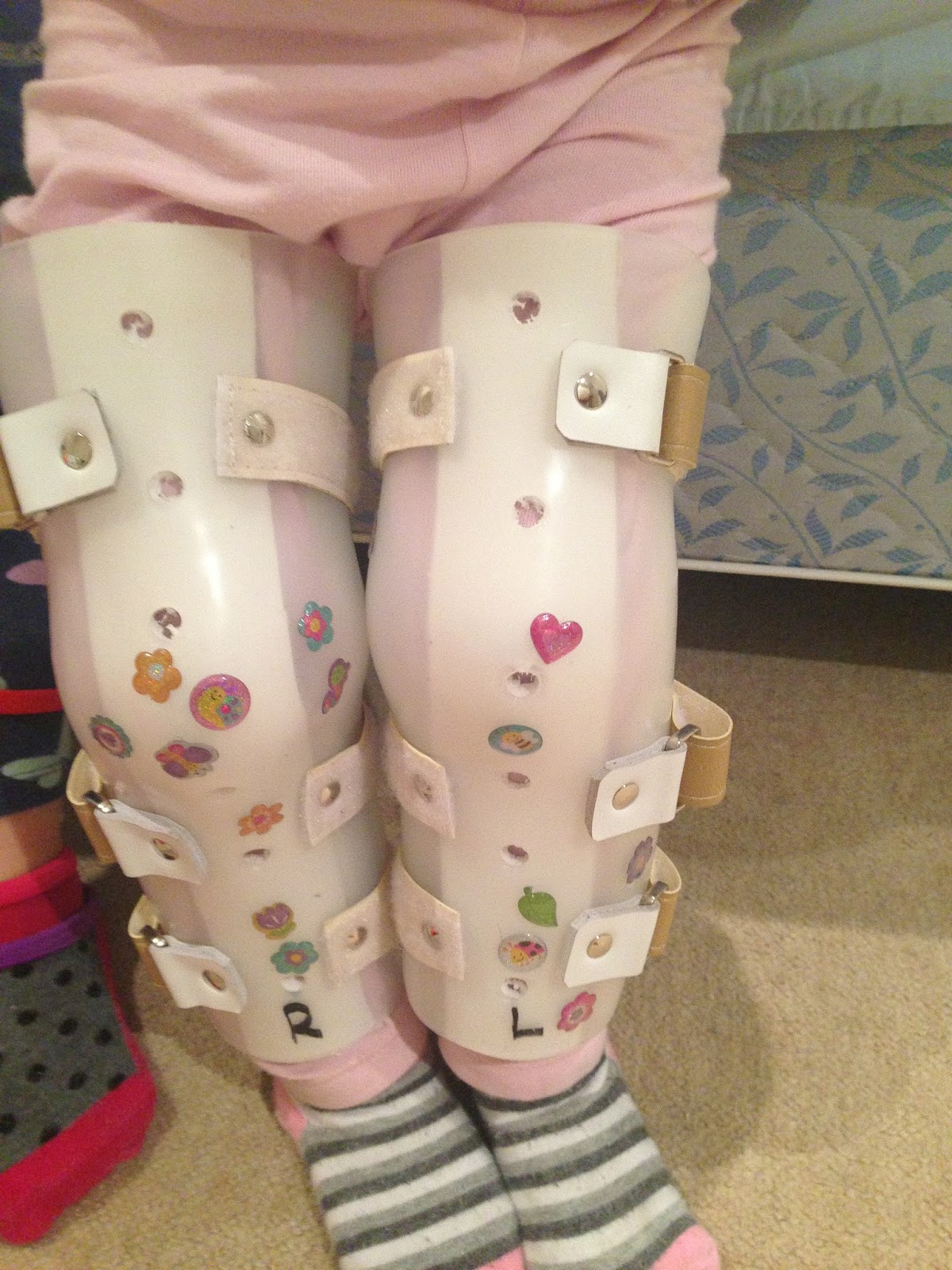
Sarah-Hope’s appetite and eating were up, but she struggled to get back on her feet after hospital. The paediatrician was concerned about the appearance of her legs and knees in particular and after some X-rays and a trip to the orthopaedic surgeon and physio, it was confirmed that although genuine weakness after the extended hospital stay was the reason she could not walk initially, there was always global knee instability. It did not look like we were going to see her walk much without an intervention. Night braces were prescribed and made. It’s interesting to reflect – about a year before, a physio had said to me she thought a particular method of plastering and bracing could help with Sarah-Hope’s legs and feet. When I googled it, I was horrified and couldn’t imagine having to watch my child struggle like that. Suddenly a year later, we’re in a position that unless we intervene, Sarah-Hope might not walk. And so I quickly became ready for braces. Amazing how you have the grace for a situation when you really and only when you need it! However, in our favour is the fact that Sarah-Hope does not have arms. And so if you put braces on her legs she really loses most function and independence. Aware of this, the doctors are conservative. And so wearing braces at night only was prescribed. And we managed it for two months until our follow up appointment.


When we went back for a check up, the orthopod was impressed at Sarah-Hope’s ability to walk again. He hadn’t said it to me at the time, but he had assumed that she wouldn’t be able to walk unless she was wearing braces to help keep her legs in better alignment. This was encouraging. Sarah-Hope seemed to be getting more energy from her diet and was getting stronger on her legs again. And just to prove it – without indicating any interest in it before, on the last day of her third school term, she climbed up the ladder and onto the top of the jungle gym all by herself. Had obviously been watching her school mates do this all year and working out how she was going to do it!

At the beginning of that term, however, despite missing being at school so much, she did not want to attend. She said the boys are wild and she can’t move out of the way when they run around. Now, just to clarify, the class of 12 children has at most three boys who are totally fabulous but obviously provide a bit of boy energy in what is a very spacious and relatively calm class environment. And yet, just that added uncertainty about somebody moving close to her made her nervous given that she may not be able to get out the way fast enough. This made me really question myself – everything in me felt that a rich curriculum in a mainstream environment was what I should expose her to – but after this physical setback it appeared as though I was totally underestimating how intimidating it was for her to be in an environment as someone less able to protect herself. Around that time I got a call from Vista Nova who had her on the waiting list for assessment asking me if we were still interested in being part of the application process. The Red Cross Developmental Clinic had referred her to Vista Nova, so we had that option to consider. I hadn’t been ready to engage with it at all, but given the timing of the call I said that I was definitely interested – I knew I had to really learn from those who accommodate the mobility-challenged as this was becoming more of a reality for us.

Unfortunately, the weekend before the week-long assessment at Vista Nova at the end of October, another tummy bug had gone through the house, and Sarah-Hope was ill again. Struggling with pain and nausea, retching, vomiting and diarrhea, her mobility declined, she fought against me putting any milk in her knowing she would be sore and unwell. It was a struggle to get her through the assessment, just because she was so obviously unwell. Fortunately the school were so understanding and accommodating and allowed me to be with her for the first three mornings. This allowed me to keep up with the tiny tube feeds that give her enough energy without making her too ill, be able to protect her in the classroom and playground from others as she was hardly able to walk or move herself, and help her feel comfortable with the environment before I had to leave her for an assessment without me. It was here that we were advised to investigate a motorised wheelchair for Sarah-Hope. This was Sarah-Hope’s first year in a school environment, and while a year before I thought we needed to be aiming simply to adapt her environment for her to perform tasks, the extent of the health setbacks and the impact on mobility meant that the reality of a wheelchair for school was getting closer - to take the burden of transport off her body, to preserve what she can do for the independence and function that is most important to her, and to give her independence. And so, after much consultation regarding the wheelchair specifications with OTs, physios and other experts, a pink motorised wheelchair was ordered to arrive in 2017.

But that is not all that she needs. Sarah-Hope is not wheelchair bound, thankfully. She will come out of her chair and sit with other children on the floor or at a desk – in fact she should be in the position that will most enable her to participate. Being on the floor means that she can use her feet to help reach certain items, for instance. And so flexibility is required. But as much as one can explore different ways of doing things, there is also the reality of a time constrained life that one with a disability and health challenges has. At one point Sarah-Hope asked me if the lady who was helping us at home could come to school with her. While we had wanted Sarah-Hope to learn to be “one of the children in the class, wait her turn etc”, she has less quantity of play experience simply because of her physical difficulties. I thought this was a good idea because the helper could continue with the small tube milk feeds during school hours, help her with toileting, as well as add a layer of protection in the classroom / playground. This seemed to go well. Sarah-Hope told me that she had put on something from the dress-up box – not being able to dress herself fully, this was obviously one of the things that she watched other children do all year but never really got around to herself. The teacher commented that Sarah-Hope seemed to be more comfortable in the class when she had the additional support. A couple of years ago, an OT friend of mine said the best way to start in school is without help, and then to add in the support that is actually required. I suppose this is what has happened this year without that being planned. And for that I am grateful.

And so, for the school journey ahead, I assume that a wheelchair and facilitator will be required. I do think there should be times when a facilitator is not around for her – those skills of thinking ahead and fending for herself are also important to gain once a level of confidence is reached. But this reality, although not being what I might have imagined a year or two ago at all, is settling in, and at least giving us some constraints to work with on the journey ahead.

Sibling strain in the context of ill health
At the start of the year, I felt comforted by the fact that Sarah-Hope and Libby were at school together. They play beautifully and so I knew they could play together there, as they were settling and getting to know the environment and people. During the month that Sarah-Hope was in hospital, Libby attended school most mornings. This helped us with logistics as I could drop her off, go to hospital to relieve Rich who spent most of the nights there and have a quick check in with him before he left to pick up Libby and look after her for the rest of the day. Libby didn’t argue for a moment – she was an absolute star and totally understood why she was going to school most mornings during this period. We also heard from the teacher that she was now for the first time actually engaging with other children at school, moving more, and flourishing in a way that she didn’t when Sarah-Hope was around. It was sobering. The months after Sarah-Hope came back from hospital were tough. Libby had had enough of holding it together and threw tantrums galore... for months. She really wanted to get some special attention – and given that Sarah-Hope had been in hospital for weeks and during this same year her father was admitted to hospital 9 times, she felt she was missing out. “Mommy, when can I have an operation?” she asked? During the second term I was planning on sending Sarah-Hope to school one morning on her own in addition to the two mornings with Libby. I wanted to use that morning to give Libby some individual attention which I have never really done other than in her first few months of life. But Sarah-Hope fell ill and so we didn’t manage more than a couple of mornings alone. One week she got bronchitis and I stayed home with her while Rich stayed on with Sarah-Hope at the hospital. She loved being home with me on her own. But I also didn’t want her to think that the attention you get from being unwell is that which should be sought after. On another occasion, I took her to the GP to be checked out. Apart from some pain meds to manage a minor temperature, she was given the clear and I said to her, “Libby, are you well enough to come on a special outing with mom?” She said she was. And we had a wonderful morning together. So I’ve tried to show her that she should never wish sickness on herself, as it is much more fun to be strong enough to go out for a special date than going between doctors,  therapists, pharmacies and hospitals. One of the hardest things to see with the chaotic health year we’ve had was the impact on Libby – obviously emotionally as she had to be shipped off to babysitters often but also the impact of an energy and mobility constrained family – she began facing challenges in her gross motor development simply because she is a highly visual learner and copies her sister’s movement patterns. Even her teachers reported that she worked very close to her body, as if she didn’t have the reach that her long arms provided her – which we assume is because she copies the way that Sarah-Hope works. She might take an item off the table using her mouth, catch a ball with her feet, not climb or swing on a jungle gym – but the more time she spent away from Sarah-Hope this improved. And so although I felt their relationship was beautiful and was so touched by Libby’s empathy and ability to play on her sister’s physical level, my heart broke at seeing this healthy and fully-bodied child so unexposed to and growing in age appropriate ways. I mentioned this to a friend of mine, saying how the school journey had been a good support because I appreciated that another adult in Libby’s life had actually noticed that she could barely kick and catch a ball (not like much of that happens in our house!) and I was finding this difficult. My friend reminded me that Libby is growing up in a very unique situation whereby she is developing such understanding and compassion for others – and that she would gladly trade the ball skills of her boys for those character qualities! So for all our lack of getting to teach Libby how to swim, ride a bike or even swing on monkey bars... we have to appreciate that she also has a very unique set of challenges. And that her emotional resilience and other aspects of development are also subject to the constraints of our household, as well as the riches. What I had found challenging at home was that whenever Sarah-Hope wasn’t well and needing more holding and picking up – Libby wanted the same physical attention. And there was so much screaming from Sarah-Hope being unwell, and then Libby screaming for attention, that just for my sanity I picked up and carried those girls again and again. I am certain that Libby would have far greater walking stamina without these months-long periods of illness and recovery in which mobility was really impaired – and most certainly if I had fought it but I didn’t. I also found that Libby wanted help in the same way that Sarah-Hope needed it. Libby would marvel that her three year old friends were putting on their own socks! When she felt loved and adored, she was happy to help and do things for herself – but when she wasn’t getting that sort of attention, she would refuse to walk / feed herself / dress / help around the house etc. It was exhausting. Because the year was one in which Richard and Sarah-Hope were very physically weak, we needed to give them plenty of support and time to recover. But I also wanted home to be a place where Libby could find generous support, a place where it would ok to ask for and receive help. I didn’t have the energy to explain to her that she needed to help me around the house while her father and sister literally were lying on the couch week after week! When playing with a friend of mine recently, she suddenly shouted at Sarah-Hope, “I’m not a grown up! I am still little!”, and another time she said to me “Why are you making me go to school all these days, I’m exhausted and I cannot do that right now!” And at other times she would simply regress into an 8 month old and crawl, bump into things and babble.

Sarah-Hope took months to recover, and I didn’t know whether to just relax into these stretches or try discipline my kids to stop the moaning. I didn’t know whether I had really taken the time to love Libby and see her before coming down on her behaviour and disciplining her. I was just confused. At the same time, although Richard was supposed to have healed from his operation earlier in the year, it became apparent after 4 months that it had not been successful. He had started a new job but was regularly taking time off to go to hospital and still had another two operations that year. I knew I couldn’t ask him for any help – he was barely managing to get by every day and had to apply himself in his new work space. I had no confidence in Sarah-Hope’s health either. I became anxious – unsure who would be in hospital next and felt powerless to plan or do anything that was important to me.

Holding on but ending the year well
I went to see my pastoral counsellor and told her that I thought I should do a redemption group (intense Bible study journey in a small group community) study on powerlessness! She told me that she would not allow me to do it unless I got more assistance at home and started exercising again. I organised this within 24 hours. Every day I would try leave home, do something that was kind to my body, read the Bible and pray. Just having some space from home and the opportunity to do something that would assist my future capacity to deal with it, helped me move forward. I went for a couple of massages, lynotherapy, pilates, swims, walks and even a few runs in the next months. Clearly I had forgotten how wonderful endorphins are! And by the end of the year I felt better than I had a year ago.

We went away for our first Christmas holiday in Knysna without Oupa around. It was a tender time, scattering ashes in the Knysna lagoon off my dad’s beloved and legendary boat, Vlertjies, and experiencing his absence in the spaces and relationships that he had built over decades. Amazingly, we were all in good health and able to enjoy the place he loved which felt like an appropriate way to honour him, which we will continue to do. 

Tuesday, 8 December 2015

Humbling set backs and cautious planning for the future

Sarah-Hope was knocked flat again at the end of June. We assumed her gut had flared up as every time she has been so flat diarrhea has followed. Thankfully it was only the Adeno virus and even though she spent three days (not nights) in hospital receiving IV fluids to give her gut a break, she went back on the infant formula Neocate for nutritional support and slowly regained strength. It was interesting being back in hospital with a 3.5 year old. For the first time, Sarah-Hope said ‘I have a sore tummy’. Last December she would just ask to be picked up but this time she could talk more about what was happening with her which was great.

But it still took two months to recover. One month for her to stand up, and another before she would voluntarily walk during play. Knowing more of what to expect, it wasn’t as difficult as before, but these periods of ill health are so humbling. How I love to plan my future – but when health is fragile, the fulfilment experienced through executing my plans for my life is a luxury I don’t presume upon.

However, a couple of months later the gastroenterologist followed up with us. Since Sarah-Hope was experiencing significant periods of health inbetween her episodes, he felt less inclined to say that she had a chronic illness. I am encouraged by that assessment at this point of time. But I don’t think I will believe it entirely for a while! As the paediatrician said to me a year ago, sometimes only time provides the answer. But suspicions aside, I do have much to be grateful for! When I think of how overwhelmed I was a year ago, I really do need to acknowledge the kindness and mercy of God in Sarah-Hope’s current health.

The reality of a healthy child for the last few months, though, has meant that I no longer am waiting for her to get sick again. I actually expect her to be healthy – amazing! And so for the first time we are considering signing the girls up for a couple of days of preschool per week in 2016. It feels like a good next step. I adore spending time with the girls but I feel that their regular exposure to older, more independent kids would provide some good stimulation for them which I can’t provide.

Sarah-Hope, now four years old, has been accepted and cherished in our home. An interesting journey is now beginning – how to help her adapt so that she can be included and contribute to the community in line with her potential. This will require some real thought – because we have not actively adapted the home environment to promote independence yet. But it's coming.


Saturday, 16 May 2015

Tears of frustration and joy

From frustration to acceptance
Currently, Sarah-Hope is in good health. I think that health means more to me than answers! That period of bad health was a blur. Sarah-Hope’s behaviour was so challenging – but it was difficult to know whether she was being totally defiant, or if she was just unwell, or if her frustrations were typical of a three year old girl– especially one who is making sense of the fact that she has little arms. “I CAN’T REACH!”, she would shout. “IT’S EASY FOR YOU!” But a couple of months on she seems to be in a space of acceptance. I asked her to close the door (I meant for her to push it closed), but she calmly said “no, I have little hands”. And so we asked Libby to do it and there was no fuss at all. “Please pass this to me, Mum”. She has also told Rich that when she is older her arms are going to grow and her hands will be able to touch each other. That made Rich nearly cry.

Tears of joy
For the first time, I feel as if I am seeing some fruit of our parenting labours. Sarah-Hope is better at saying thank you and please and in a decent tone too. This has been really important for me – because she won’t be able to do everything for herself, Sarah-Hope must learn to make valid requests with proper respect to get things done through and with other people. Her physio reminds us that the ultimate goal is collaborative partnership – not independence. So I am delighted that her manners are improving – admittedly I benefit the most from this!

Sarah-Hope is singing! For the second part of 2014 she was going to a music class which she enjoyed but never showed any signs of participation despite being slightly older than the other kids in the class. And then in January this year, she suddenly started putting on her own little music classes for her dolls and animals! She switched on her little toy computer, played a song, shook a rattle, and lined up all her stuffed friends to join in the fun. To hear a child laugh, play and sing is a beautiful thing. So songs and rhymes are becoming firm favourites as well as these special music making times.


Sarah-Hope’s imaginary play is stunning. In many ways it is a relief – she is far less frustrated than when she is playing with physical toys which she may struggle to manage depending on their weight and shape. Here she is free to pick up and hold her babies, pets and friends… and so this may result in her having greater imaginary play than she might have with a full working body... What a great outcome! Sarah-Hope loves her little cousin, Jessica Rose Whyte.

This year Sarah-Hope has also taken on some water physio classes. She is always slow to get into the water. She loves the feeling of being splashed on her back but I think that since she can’t wipe water off her eyes and most of her face she finds her defencelessness rather threatening. We have gone from taking most of the session to get into the pool but are making progress. The idea that she gets to have toys in the pool is very exciting to her. We would love her to learn to swim at some point but are just working on her relationship with water for now, keen to build a solid foundation of love for the water.